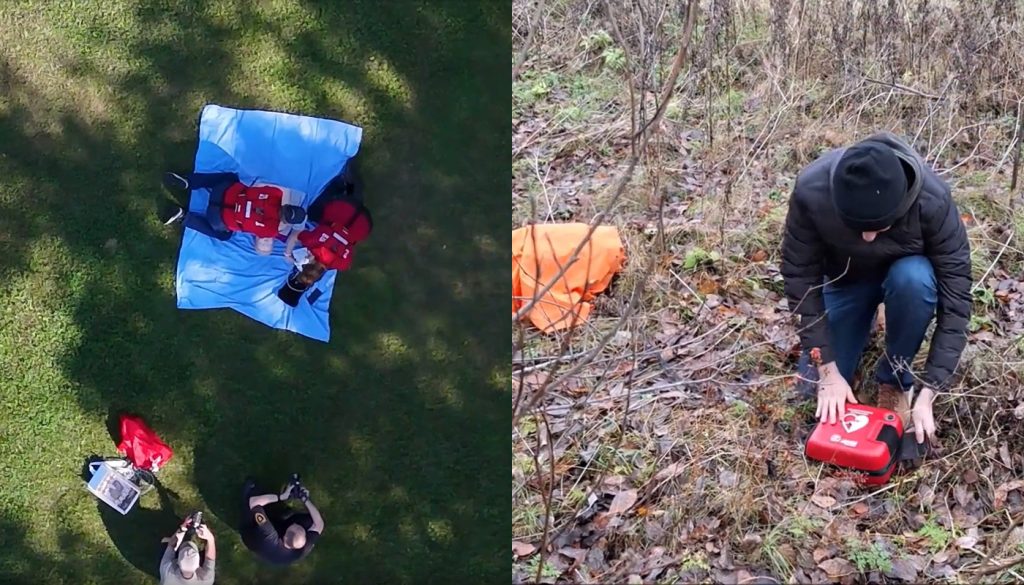
Defibrillators and medicine
When transporting a defibrillator, every second counts. Delivery drones offer significant benefits to healthcare, particularly by speeding up deliveries, reducing costs, and reaching hard-to-access areas. Unmanned aerial vehicles can bypass traffic congestion and poor road connections, making them a highly effective means of transport in emergency situations.
Lentola’s drones can deliver urgent medical supplies directly to where they are needed. For example, antivenom for a viper bite can be flown directly to a remote location or the archipelago. In the event of a cardiac arrest, a drone can deliver a defibrillator to the scene minutes before a medical helicopter arrives.
Lentola designed its user interface to be so simple that errors can be avoided even under extreme time pressure. The route and drop-off point can be programmed into the system in moments with just a few clicks, which can be crucial to a patient’s chances of survival.
Below is a comparison of defibrillator delivery by drone versus helicopter.
A defibrillator can be airborne within one minute when transported by drone. A drone optimized for this purpose can reach speeds of approximately 150 km/h, while a helicopter can fly at around 250 km/h.
When a defibrillator is transported by a medical helicopter, the team can take off in under four minutes after receiving an emergency call under optimal conditions. Although a helicopter can fly faster than a drone, its base is likely to be much farther away. Most helicopters are also unable to operate in the most challenging weather conditions, such as icing conditions. Landing a helicopter is time-consuming, and finding a suitable landing site is sometimes impossible.
→ If a drone takes off from a rescue station in the Turku archipelago, it can likely deliver a defibrillator to the patient 5–10 minutes faster than a helicopter.